I am a convert to the Mennonite faith. I am not an ethnic or cultural Mennonite, as I’ve heard them described. My family lineage includes Pennsylvania Dutch and some of my family spoke Low German until my Great Grandparent’s generation, but as far as I know they had no Anabaptist affiliation.
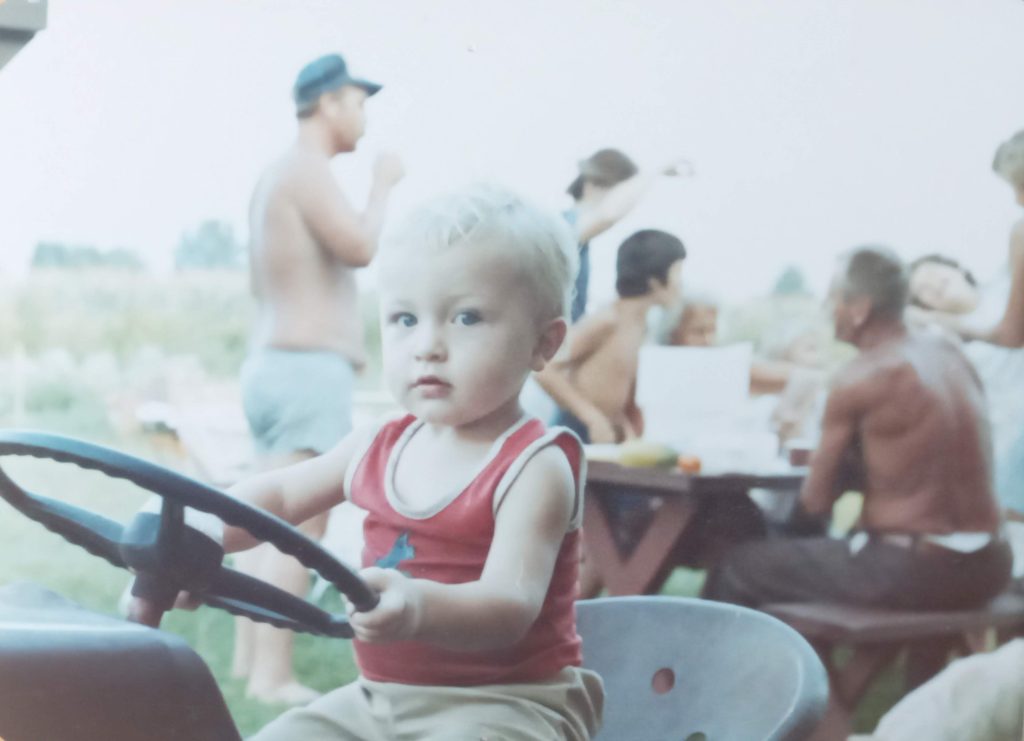
Young Me pretending to drive the lawn tractor in North Carolina.
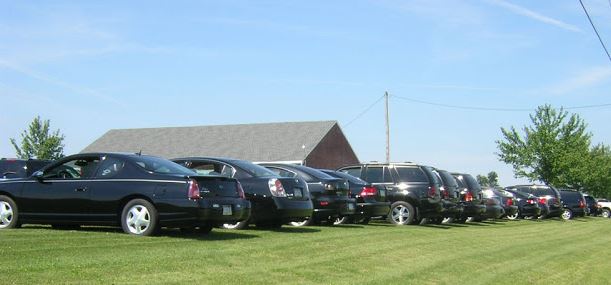
Growing up, my Mother’s side of the family were hardline Fundamentalists and my Father’s side of the family were Episcopalian. When I was 12 years old my parents separated – they would divorce a few years later – and I moved with my mom from North Carolina to her home state of Pennsylvania along with my two younger brothers. My oldest brother made the decision to stay in North Carolina. Our landlords were friends of my mom’s family who had become Mennonites and we started attending meeting with them. This community was what we called “Black Bumper” Mennonites. They had many similarities with “Old Order” Mennonites but they drove cars (all black), had electricity, and used technology. I don’t know if they were affiliated with Weaverland Conference or were another branch.
“Black Bumper” Sunday Meeting
There were no musical instruments during service. Men and women sat on opposite aisles. Women wore cape dresses and were silent in the church except for singing. There was no Pastor. The Elders cast lots to see who would preach on a given Sunday. They were intellectually rigorous with large well-read libraries and they strongly emphasized service, non-resistance, simple living, and the separation of church and state. In addition to the Bible we read Martyrs Mirror and other texts. They taught that voting, calling the police, holding insurance, and investing money demonstrated a lack of faith. They taught that the community of believers should care for one another’s needs. I don’t remember what they believed about medical care and medicine.
As a Fundamentalist I had grown up on stories of missionaries and martyrs, but before this I had never met Christians who were so deeply committed to personal service or who regularly left their own community to do service. Not only did they say that Christians were the hands and feet of Jesus – they tried to live that out. I remember listening to the family of mechanics talking about their service trips to other countries and feeling so certain that this was what Christianity was suppose to be. Christians should be looking beyond ourselves and their immediate community. As a young teenager they included me in their adult small groups and answered my questions seriously. They taught me about nonresistance as a matter of faith, citing the teachings of the Jesus as well as Old Testament examples of the folly of relying on weapons and military alliances instead of God. They struggled with questions like what they would do if someone attacked their family and doubted if they would have the faith to just pray instead of intervening. I mean no disrespect when I say that they were radicals, striving to be, “In the world but not of the world.” The Beatitudes and Romans 12 were cornerstone scripture for them.
Do not conform to the pattern of this world, but be transformed by the renewing of your mind. Then you will be able to test and approve what God’s will is—his good, pleasing and perfect will.
Romans 12:2
We almost become members. In the final membership meeting they told us that we would need to dress like them and follow their rules. My Mother agreed. Then they said that she had to return to my Father and be reconciled to him. They promised that they would support us but insisted that this had to happen. It’s not my place (nor is this the space) to tell my parents’ story but that was the end of our time with these Mennonites. It is easy for me to romanticize the “Black Bumper” Mennonites for their commitment to nonconformity, service, simple living, intellectual rigor, and nonresistance. However, I am aware that I was oblivious at the time to the negatives of that kind of community – for instance, forcing members to conform to non-conformity through shunning and the experiences of women and girls.
It was a dark time for my family after that. In the midst of these troubles, my Mom met a woman in Chambersburg named Carolyn George who invited us to a circle dance at her church. I was raised hardline Fundamentalist and had just come out from a conservative Mennonite community, so the idea of a church hosting a dance was shocking to teenage me. When we arrived I was even more shocked to see that the Pastor was a woman – and beyond that, a woman wearing pants!
The Pastor was Joyce Musselman Shutt. She was the fourth or fifth, depending on how you count, woman ordained in the Mennonite church in the United States. The church was Fairfield Mennonite Church near Gettysburg, Pennsylvania. The church motto was “A Place of Hope and Healing.” It was unlike any church that I’d had attended up until then in my life. People from all walks of life attended. There was no dress code. No strict rules of orthodoxy. Hugs were freely exchanged. Fairfield Mennonite had an active prison ministry, outreach to the poor and homeless, and engagement with mental health programs. One churchgoer might be a University Professor and next to them might be someone who had recently been homeless. Fairfield Mennonite was a peace church, actively protesting militarization, yet I met combat veterans there. At some point I had absorbed a deep distrust of Catholics, even before reading Martyrs Mirror, and here Fairfield Mennonite was organizing anti-war protests with the local nuns. The congregants were open about their brokenness in a way I hadn’t experienced before.
We began to attend immediately after that first encounter. Several church members later told me that I looked much older than I was at the time. I’ve been told I looked haggard, old, like I was carrying the weight of the world. The churchgoers weren’t sure if 15 year old me was my mom’s son, brother, or husband. I was deeply troubled and traumatized at that time. I had been bullied viciously in elementary school then homeschooled in an increasingly isolated manner for six years, my family had been broken, and there were other issues that I won’t go into here. I feel like the stereotype for a troubled teenager is that they externalize but I think that they just stand out more than those of us who internalized our troubles. I obsessed over even the smallest worry. One night during this time I was so tense worrying about something minor that I actually snapped a muscle in my neck and that’s why my head at rest is to this day slightly tilted to one side. My answer to every situation, every problem was a desire to avoid, to shrink, to disappear. Hide in a corner and wither away. My back was hunched, the deep wrinkles in my brow date back to those years. I was anxious, afraid, and tense. I was atrophying.
Norm and Charlotte (as a Baby) during the 2014 Gift Festival at Fairfield Mennonite.
More than anything else, Fairfield Mennonite is a service church – love is a verb – so I didn’t get to sit in the corner and fade away. I was put to work helping at the Food Pantry, helping with all of the activity around Gift Festival, and so on. My first trips to Akron, Pennsylvania were to help pack fair trade goods at the old shoe factory that served as the Ten Thousand Villages headquarters. The good people of church engaged me and pulled me out, even when I wanted to avoid them. I needed the push. In my trauma and neurosis, I just wanted to retreat away into my mind. They wouldn’t let me and that’s exactly what I needed. I needed to be pushed and pulled into living. I wasn’t strong enough to seek out healing on my own.
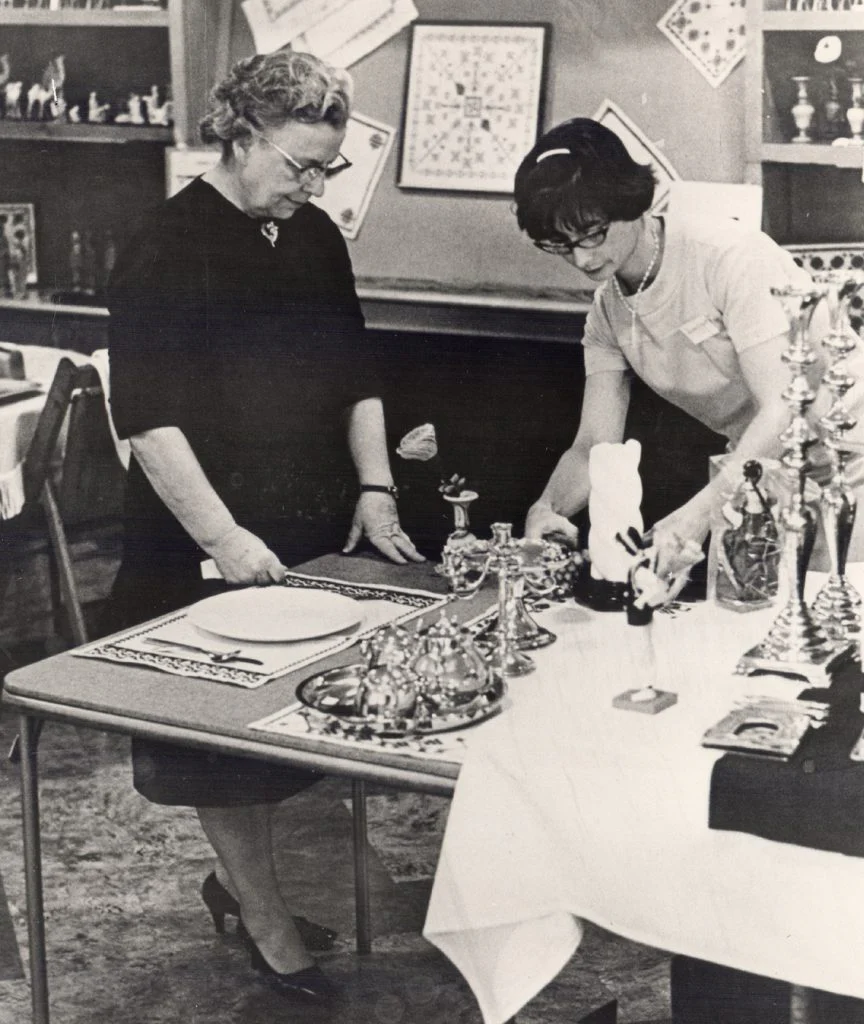
Edna Ruth Byler (left) with Joyce Shutt (right) at Fairfield Mennonite’s Gift Festival in 1968
Fairfield Mennonite Church was the original ‘fair trade’ Gift Festival church with strong connections to Ten Thousand Villages and Edna Ruth Byler. As Pastor Joyce wrote in reflection of the 50th anniversary of Fairfield Mennonite’s first Gift Festival, “September 1961. Just back from a two-year term with Mennonite Central Committee (MCC), I took my mother to visit Edna Ruth Byler’s basement gift shop. Mrs. Byler, seeing my mother’s reaction to all those lovely things that didn’t carry the Old Mennonite seal of approval, confided that the plain churches she visited were not a receptive market for many of her products. To which my mother said, “Give us everything you can’t sell and we’ll sell them for you. We’re GC’s (General Conference Mennonites). We’re worldly Mennonites!” And so in a real way the International Gift Festival and Ten Thousand Villages was born.” I’ve noticed that the story of fair trade is usually told beginning with Edna Ruth Byler and then jumps to the stores (Self Help Crafts and Ten Thousand Villages), but I think the interim step when fair trade went from one woman’s personal ministry to a community movement (and a women led one) shouldn’t be overlooked.
Through Ten Thousand Villages, for the first time, I met people from around the world such as Pakistani weavers. Through service this little church in a small rural town on the outskirts of Gettysburg became a gateway to the world. I had long been a voracious reader and now I was meeting real people from places I had only read about.
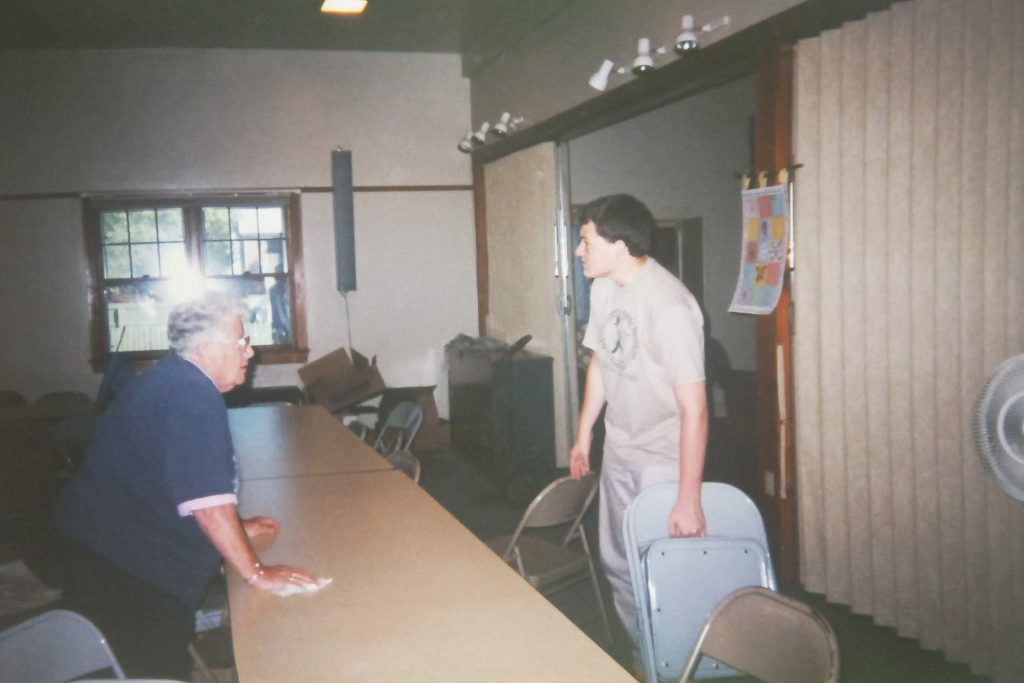
The only photo I have of Floss and I.
Again and again and again. There were so many people there who each played a part in changing the trajectory of my life. Homer pushed me to go to public High School and grow up. My first real friend outside my family, maybe in my life, was a retired teacher named Floss. Liz gave me my first job and gave me space to be a teenager. I wrote about how Earl Shutt encouraged, challenged, and supported me. Dr. Long met with me for counseling sessions. Bonnie. Brenda and Fran. Lolly. The Nunamakers. The Roths. The Georges. Bob Smith. The Kammerers. So many others. There were so many people who changed my life for the better. This community was transformative to me. Fairfield sent me to Camp Eder, a nearby Brethren in Christ summer camp, where I spent a week away from my family for the first time. One of the Camp Counselors had just returned from a term with Christian Peacemaker Teams and I still vividly remember his stories. Fairfield was where I was shown the way to the path of healing and hope. This was a community that pulled me back into being someone my own age while also pushing me forward.
In regards to me continuing to be a Mennonite – not just personally becoming a healthier and more capable person from my time in this community – Pastor Joyce and her husband Earl played the largest role. Pastor Joyce set aside time for me, having me over for dinner with her family and then meeting to mentor me afterwards. She openly shared her from her personal experience – years later I was reminded of her approach when I read Henri Nouwen’s The Wounded Healer – and challenged me intellectually and ethically. She found a common language to reach me, the language of books, encouraging me to read and report back on what I thought. The summer after I graduated from High School I was baptized in a cold mountain brook by Pastor Joyce.
Despite all of the support and encouragement, I probably still wouldn’t have attended College after graduation if it hadn’t been for Pastor Joyce and Earl. The Shutts were alumni of Bluffton College – a Mennonite school in Ohio – and encouraged me to attend. Pastor Joyce’s family, the Musselmans, were long time supporters of the school and the library still carries their name. The Shutts took me out for an exposure visit and I stayed in the dormitory overnight. I remember that the student hosting me was growing a stalk of corn in his dorm room and that I found that reassuring. Maybe this was a place where it was okay to be quirky. I was very quirky from trauma and isolation…and maybe just by nature. The Shutts encouraged me to apply and – when I had an anxiety attack and stopped when I was almost done the online application – Bluffton called me to ask the questions to finish the application. Homer helped me with the FAFSA application for student loans and the Shutts helped me financially.
At Bluffton, I met many international students in my class and quickly became a regular member of the International Club. I was fortunate to count many wonderful international students among my friends during my time there and I don’t know that I would have without those early intercultural experiences with Fairfield and Ten Thousand Villages. I became friends with the Vietnamese Professors who had come to Bluffton to get their Masters in Education from a US University.
The September 11th attacks occurred during my first year at Bluffton. As a Mennonite I had already registered as a conscientious objector and – as many were afraid that the draft would return – I attended a CO registration event hosted by Professor Perry Bush to share from my personal experience. I was shocked by the backlash the event received at a Mennonite College and that lead to me joining the Peace Club. Through this I joined protests against the second Iraqi war and the School of Americas, as well as organizing peace events on campus – the most successful was focused on migrant labor and we invited Bluffton College alumni Baldemar Velasquez back for the first time since he graduated. For two years I was elected the president of the Peace Club. I was also president of the Japanese Animation Club for a year, was secretary of the Macintosh users club, and served on Student Senate for a year. The High School me never would have imagined doing these things but Bluffton was a place where I took the next steps on that path of healing and hope that Fairfield had set me on.
Bluffton University (as it became in my second year) required it’s students to do cross cultural studies. Still avoidant at times, I was planning to request an exception because how could I even leave the country but I took a lot of history courses (despite being a Computer Science major) and Dr. Dan Wessner recruited me to join the Vietnam cross-cultural. My paternal grandfather had been a US Marine in Vietnam and that deepened my interest in joining the program.
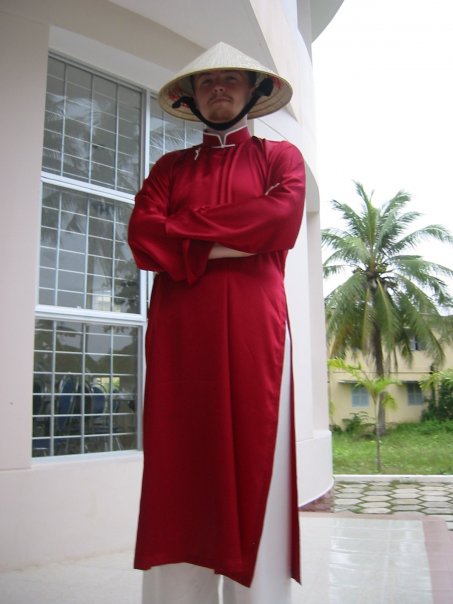
Wearing my áo dài during my cross-cultural in Vietnam
In Vietnam I taught English, American Culture, and Computers as a Student Teacher at An Giang University. I visited Can Tho where my grandfather had been stationed and crawled through the Cu Chi tunnels. I visited the War Remnants Museum in Ho Chi Minh. In the north I visited Chu Dau, one of the “Ten Thousand Villages”, a pottery village that had been stained black with coal soot and, beyond the aesthetics, the villager’s lungs had suffered for it. They told the story of how fair trade changed that, transforming their village by providing fair wages that allowed the pottery kilns to switch to cleaner burning fuel. They had hope for their children and health because of fair trade. Eric Burdette and I become the first students to repeat the Vietnam cross cultural returning the next year (after graduation we also both signed up for three year terms with MCC – Eric in An Giang, Vietnam and me just across the border in Prey Veng, Cambodia). Dr. Wessner had served with Mennonite Central Committee in Vietnam in the 1990s and An Giang University was a MCC Vietnam partner at that time. This was not a standard cross cultural where we just did some service and learned from the experience – Dr. Wessner had an ambitious plan and many partners, we were helping An Giang University build an online platform (this was before apps and social media took off, more like an online forum or wiki) for Vietnamese rice farmers to share techniques, questions, and learnings while also working with the University to pilot a new education approach with the Vietnamese Professors with a heavy focus on intercultural competence. My part in all of this was very small but it was bold and inspiring initiative to be even marginally attached to. During the cross cultural, I met Dr. Võ Tòng Xuân, who is famous in Vietnam as Dr. Rice for promoting new agricultural techniques and research that helped end famine. It was with Dr. Xuân that we traveled to a village on the Cambodian border – his homeland – and he shared about this area being attacked. I saw the blood stains up to above my head on the walls of the pagoda where the villagers had fled for shelter. This was my introduction to the Khmer Rouge. I didn’t know it at the time but when I looked across the dusty border I was looking into Prey Veng province where I would be living in a few years.
At Bluffton University I studied Biblical Literature, Christian Ethics, and Theology with Professors like J. Denny Weaver and Laura Brenneman. I took History courses – unrelated to my Computer Science degree – with Professors like Perry Bush, James Satterwhite, and Dan Wessner. Of course, I also took Math and Science classes with Professors like Mike Edmiston, Stephen Harnish, Art Shelly, and Darryl Nester. The Professors took sabbaticals with Christian Peacemaker Teams and Mennonite Central Committee. In my Senior year I was somewhat randomly recruited for Men’s Choir as a Second Tenor – the director heard my voice as I was talking about Vietnam (maybe loudly?) and came over to recruit me – and realized a bit too late that I enjoy singing in a group. More than anything else, Bluffton gave me a safe space between childhood and adulthood where I could be challenged, nurtured, and healed. I had a lot of healing and growing to do.
Crystal Graber
At Bluffton I met a beautiful young woman named Crystal. She was my friend Ben’s younger sister so, not really knowing what was honorable, I decided to stay far away from her and gave her the cold shoulder at our first meeting. But then we kept on running into each other – at Peace Club, at International Club, playing tabletop games with her brother. Eventually we became friends and later we became romantically involved. I had long prayed that my life partner would be someone who was either very much like me – so that we could relate – or very much my opposite – so we could balance each other out. Crystal was an answer to that prayer. She is both very much like me – we hold the same values and world views – but also very much my opposite – we have totally different ways of thinking and acting. Unlike me, Crystal is an ethnic or cultural Mennonite of the Graber and Waltner lineages. Not only was she a PK (Pastor’s Kid), she was also a MK (Missionary Kid).
After several wonderful years where I made lifelong friends and became closer to the person I am now, I graduated from Bluffton University with a degree in Computer Science…
Years prior to my graduation, Pastor Joyce and her husband Earl had told me how their years of voluntary service with Mennonite Central Committee had changed their lives. They had encouraged me to sign up for a three year term while I was still young – before I had a family or a career. They told me it would change my life. They shared – with some wistfulness – that they had always wanted to do another term but advised that once life takes hold it doesn’t let go. So instead of looking for work with my new Computer Science degree and staying close to the wonderful woman who I was romantically involved with, I signed up for three years of international voluntary service with Mennonite Central Committee. It worked a little differently back then. I was interviewed and then asked where I was willing to go. I answered that since I was young I was willing to go anywhere. I was open to God sending me where I was needed. Then they called me back and said that they wanted to send me to rural Cambodia to work in agriculture. I was surprised. I thought that I’d be teaching technology – which I did in Vietnam – or English – which I also did in Vietnam. Not working in agriculture. I knew enough about rice farming from my time in Vietnam to know that I didn’t know anything about rice farming. I did grow up on a farm before my parent’s separation and I had been in 4-H, but that kind of farming was not like rice farming. But I had also made a commitment to God that I’d go wherever I was sent and so that’s how I ended up in rural Prey Veng province for three years.
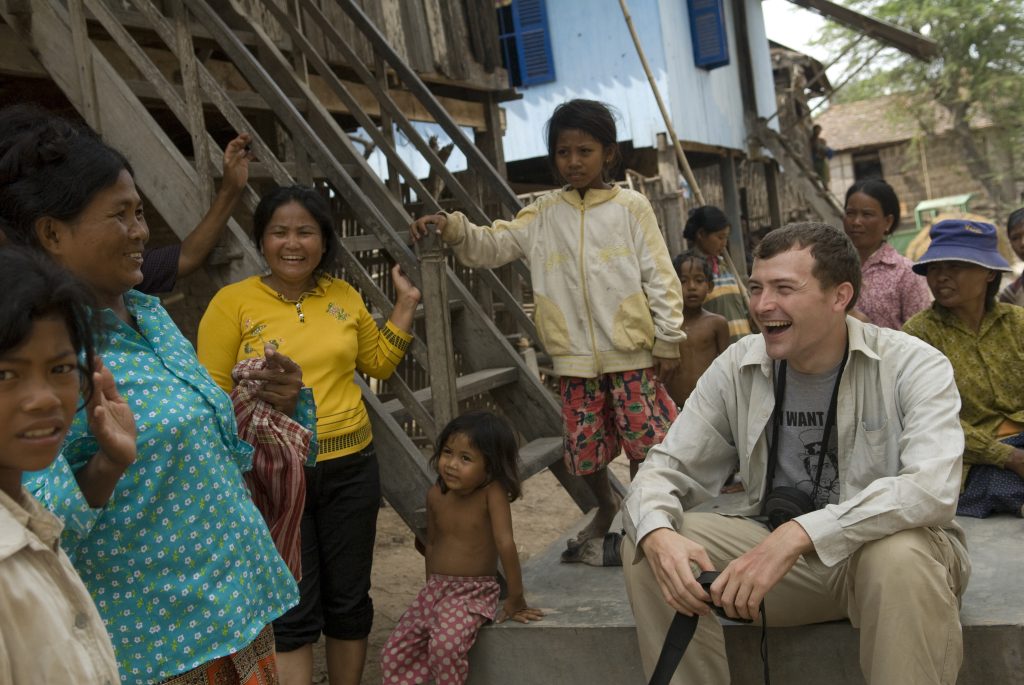
2009 photo of me laughing with locals at Angkearhdei village
Those three years of voluntary service in Prey Veng were both extremely challenging and extremely rewarding. It turned out that I didn’t need to be an expert on rice farming – Cambodian farmers are already experts on rice farming – but I was able to help with Canadian government grant reports, helped start a field office, started a primary school project, and provided other administrative supports. I even got to repair computers a few times.
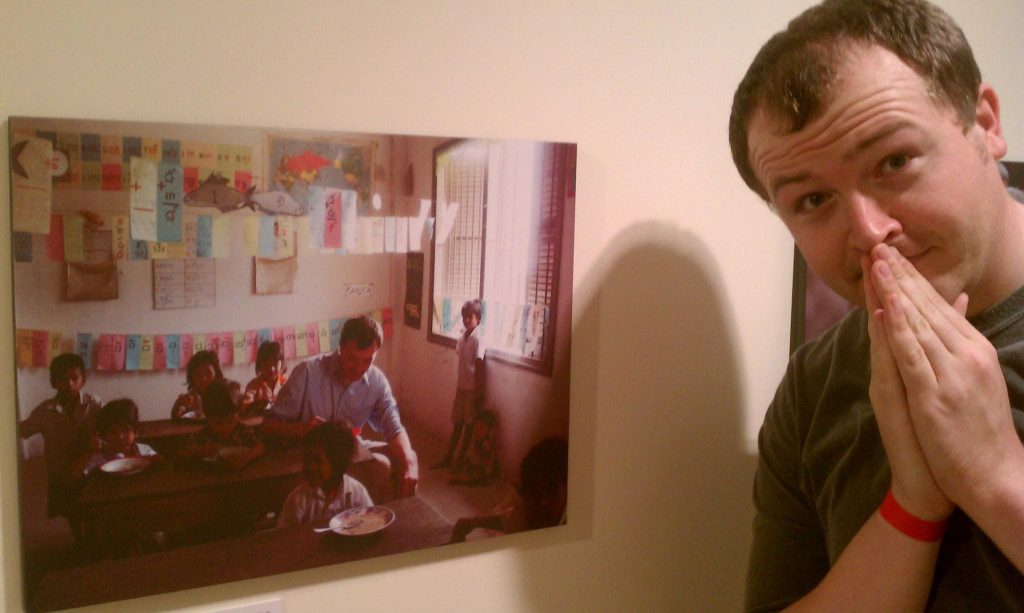
Photo of me in Cambodia at the Mennonite Heritage Center.
For many years I liked to joke that I had “made it” as a Mennonite when a photo of me was hung at the Mennonite Heritage Center in Harleysville. The Mennonite Heritage Center was highlighting Mennonites from the region who had done voluntary service and I happened to be the one asked to represent Eastern District Conference. This was a few years before I started working at Peaceful Living and got to know the Mennonite Heritage Center team – quite well in fact, they were our landlords and for awhile I was their primary contact!
But that’s just a joke. The truth is that I “officially” became a Mennonite when I was baptized in a cold mountain brook by Pastor Joyce and unofficially that it’s has been a continuing journey that God started me on when I was at my most broken. It’s been a journey of healing and hope for me. One full of wonderful people who in the midst of their own brokenness did what they could to be Christ to others.
That’s quite a moving story, Charles, thanks so much for all the details and remembering so well the turning points along the way… thanks be to God for the community of support around you.



That’s a beautiful, thought provoking life story. You are demonstrating to your children a life experience that is filled with meaning.
So good to hear your faith journey. Very touching.
What a wonder-filled, remarkable , well-written story of openness and discovery. Thank you so much for sharing.
What a beautiful story of God’s grace. Thank for sharing your journey.❤️
That’s quite a moving story, Charles, thanks so much for all the details and remembering so well the turning points along the way… thanks be to God for the community of support around you.